Thursday, April 03, 2008
Off to London - Trip over.
Today we are flying back to London for the night. The trip is over! I'll be in Flagstaff (with luck) on Friday night. Keep looking here for other blogs from Arizona. Thanks for reading.


Uganda
 Colorful Uganda! What a welcome we received. This woman was part of a colorful dance troop that greeted us at the airport. Each African country has its own flavor and the people of Uganda seem very easy going and happy. Contrast that with what most of us know of the country, a certain person named Idi Amin. Strange how such tiny bits of information tend to keep us from really knowing the depth and breadth of things.
 Check out this hippopotamus in its very own private pool! We traveled to the far western end of Uganda to Queen Elizabeth National Park to see the wildlife here. Unfortunately, we learned that these hippo's are subjected to poaching by some of the locals and there are guards of rangers that patrol these pools at night.
 A close-up view. They are amazing!
 At another location we saw this encounter when one male tried to get in the water with the harem of the dominant male. The dominate male would have no part of it and came out the water to chase down the interloper. A fast paced chase ensued. The hippo is considered one of the most dangerous animals in Africa and people die all the time from their encounters with them. They are extremely fast for large animals.
Wildlife and People in Tanzania and Ngorongoro Crater
Next on the trip was a stop in one of my favorite countries, Tanzania. The people are very friendly and I love learning words in the Swahili language (surprisingly easy).
 This first view is of the East African Rift during a rain storm. This faulted rift is hugely responsible for the drying out of east Africa in the last few million years, a geologic event that caused a certain species of primate to adapt and change - the cradle of humanity exists here.
 Zebra in Ngorongoro Crater.
 A warthog.
 Elephants.
 A lion on the hunt. I always encourage my friends who have pre-teen children to come on safari in Africa. It is so amazing to see this wildlife in its native habitat. Despite fears in the US, Africa is a friendly and easy continent to visit. Seeing this splendor is a life altering experience and one that children can keep as a memory forever!
 Next we visited a Maasai village and saw these colorfully dressed women in a dance.
 The maasai men and known worldwide as tremendous jumpers and during the dance we saw them perform. Amazing!
 This first view is of the East African Rift during a rain storm. This faulted rift is hugely responsible for the drying out of east Africa in the last few million years, a geologic event that caused a certain species of primate to adapt and change - the cradle of humanity exists here.
 Zebra in Ngorongoro Crater.
 A warthog.
 Elephants.
 A lion on the hunt. I always encourage my friends who have pre-teen children to come on safari in Africa. It is so amazing to see this wildlife in its native habitat. Despite fears in the US, Africa is a friendly and easy continent to visit. Seeing this splendor is a life altering experience and one that children can keep as a memory forever!
 Next we visited a Maasai village and saw these colorfully dressed women in a dance.
 The maasai men and known worldwide as tremendous jumpers and during the dance we saw them perform. Amazing!
Tuesday, April 01, 2008
Victoria Falls!
This is truly one of the remarkable places on Earth! (I guess that's why it is one of the Seven Natural Wonders of the World). By the way, the others are: Grand Canyon; Paricutin Volcano; the Northern Lights; Great Barrier Reef; the harbor at Rio de Janeiro; and Mt. Everest. I have been to them all except that tiny volcano in Mexico.
 Here's a view from the helicopter looking downstream. The vapor, or "the Smoke that Thunders" is clearly visible.
 Another view that shows some previous geologic locations of the falls. Each gorge (on the right) is an old lip of the falls. You may be able to detect the location of the next falls by the way the water shimmers in a line just above the present falls (left). Fantastic eh!
 We visited the falls at the end of a very wet rainy season and the amount of water flowing down was stupendous.
 Look at how wide the Zambesi River is above the falls and then how narrow and engorged it becomes below the falls. We took a scenic boat cruise on the upstream section and saw many wading hippo's in the water.
 Here's a closer view from the ground of the Eastern Cataract on the Zambian side of the border (the river is the international boundary between Zambia and Zimbabwe). In the dry season, this section of the falls is often completely dry.
 Here's a view from the helicopter looking downstream. The vapor, or "the Smoke that Thunders" is clearly visible.
 Another view that shows some previous geologic locations of the falls. Each gorge (on the right) is an old lip of the falls. You may be able to detect the location of the next falls by the way the water shimmers in a line just above the present falls (left). Fantastic eh!
 We visited the falls at the end of a very wet rainy season and the amount of water flowing down was stupendous.
 Look at how wide the Zambesi River is above the falls and then how narrow and engorged it becomes below the falls. We took a scenic boat cruise on the upstream section and saw many wading hippo's in the water.
 Here's a closer view from the ground of the Eastern Cataract on the Zambian side of the border (the river is the international boundary between Zambia and Zimbabwe). In the dry season, this section of the falls is often completely dry.
Madagascar's Spiny Desert and Lemurs
My trip continued into Madagascar, truly one of the most unique places on earth. I learned in previous visits that most people here practice a form of ancestor worship. On this trip it was told that in some tribes all material possessions upon death are placed within the hut and burned! There is no descendency of wealth to the children. This was a completely foreign concept to some of my fellow travelers, who saw it only as a waste of resources. It did make some sense to me since I commonly witness people in my culture who's experiences cause them to have a complete lack of appreciation for money won with hard work. The Malagasy culture never ceases to surprise me. The lemurs were great too. Here's a few pictures of the unique desert and the lemurs.
 Madagascar's Spiny Desert
 One of the dominant plants is Didera, something akin to our ocotillo but different.
 Madagascar has received a lot rain recently and the Didera was leafed out big time.
 The ringtail lemur!
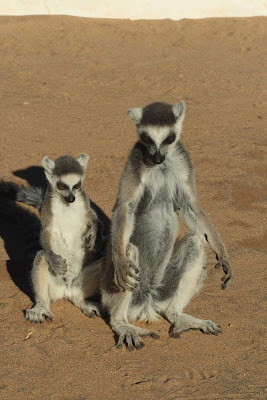 Here's another one with its young nearby.
 This ringtail lemur loved eating the pads of the prickly pear cactus (introduced).
 This lemur is called a Sifaka and truly is a gem to watch on the trees. However.....
 They do come down to the ground to cross an open patch in the forest and they do this lovely little waltz on only two legs!
 Madagascar's Spiny Desert
 One of the dominant plants is Didera, something akin to our ocotillo but different.
 Madagascar has received a lot rain recently and the Didera was leafed out big time.
 The ringtail lemur!
 Here's another one with its young nearby.
 This ringtail lemur loved eating the pads of the prickly pear cactus (introduced).
 This lemur is called a Sifaka and truly is a gem to watch on the trees. However.....
 They do come down to the ground to cross an open patch in the forest and they do this lovely little waltz on only two legs!
Saturday, March 22, 2008
Down to Southern Africa
We transitioned to southern Africa on March 18 visiting Namibia and South Africa.
 Namibia in places looks a lot like the Mojave Desert (one of my favorites). The Namib Desert is typically drier but just as interesting.
 Here you can see some of the black dikes that course through the light colored granites. The dikes were intruded about 120 million years ago, when the southern continents were rifted apart. The granites were formed about 560 million years ago in a huge mountain building event.
 Look at these fantastic folds in the granite and gneiss!
 Here is one of the most interesting plants found in the Namib - the Welwischia. It can be over 1,500 years old and is found only in a narrow band of ground a certain distance from the coast. This was one we came across on our 4X4 desert tour.
 Here is a close-up view of the Welwischia. There are only two leaves on each plant and the border of the two here split left to right in the photo. The wind splits them apart making it seem like more than one leaf.
 We also took a scenic flight over the dune fields of Namibia. Our planes were agile and low flying. This was certainly not for sissies!
 A number of old abandoned diamond camps were seen on the flight. This coast has lots of placer deposits of diamonds - those are fields where ancient rivers transported diamonds to the beach.
 Look at these coastal dunes! Awesome aren't they? Well, this could be a modern analog for what environment the Toroweap and Cococnino sandstones were deposited in over 275 million years ago! I love time travel!!
 A view of our lovely hotel in Swakopmund!
 I put this photo in the blog for my friends Norm and Don and Bill back home who all love to go camping in the desert! We saw this great sunset and I thought of them! Beautiful high cirrus clouds at sunset.
 Desert dancers greeted us at a night time dinner in the desert, complete with a flame show. I put this one in for Helen so she'll know how much my love still burns for her, half way around the world!!
 We got to fly from the capital at Windhoek out to the Namib in an old and restored DC-6. She was a beaut!
 Look at those engines whirring away over the mist shrouded desert.
 Granite landscape in Namibia.
 Namibia in places looks a lot like the Mojave Desert (one of my favorites). The Namib Desert is typically drier but just as interesting.
 Here you can see some of the black dikes that course through the light colored granites. The dikes were intruded about 120 million years ago, when the southern continents were rifted apart. The granites were formed about 560 million years ago in a huge mountain building event.
 Look at these fantastic folds in the granite and gneiss!
 Here is one of the most interesting plants found in the Namib - the Welwischia. It can be over 1,500 years old and is found only in a narrow band of ground a certain distance from the coast. This was one we came across on our 4X4 desert tour.
 Here is a close-up view of the Welwischia. There are only two leaves on each plant and the border of the two here split left to right in the photo. The wind splits them apart making it seem like more than one leaf.
 We also took a scenic flight over the dune fields of Namibia. Our planes were agile and low flying. This was certainly not for sissies!
 A number of old abandoned diamond camps were seen on the flight. This coast has lots of placer deposits of diamonds - those are fields where ancient rivers transported diamonds to the beach.
 Look at these coastal dunes! Awesome aren't they? Well, this could be a modern analog for what environment the Toroweap and Cococnino sandstones were deposited in over 275 million years ago! I love time travel!!
 A view of our lovely hotel in Swakopmund!
 I put this photo in the blog for my friends Norm and Don and Bill back home who all love to go camping in the desert! We saw this great sunset and I thought of them! Beautiful high cirrus clouds at sunset.
 Desert dancers greeted us at a night time dinner in the desert, complete with a flame show. I put this one in for Helen so she'll know how much my love still burns for her, half way around the world!!
 We got to fly from the capital at Windhoek out to the Namib in an old and restored DC-6. She was a beaut!
 Look at those engines whirring away over the mist shrouded desert.
 Granite landscape in Namibia.
More From The First Half of the Africa Adventure
 Lome, the capital city of Togo, sits on the southern coast of West Africa. It is just west of Nigeria and Africa's geologic "elbow". There are colorful shoe shops here!
 We visited a fetish market and saw these primate skulls, used in voodoo ceremonies. Shame to see such religious superstition which unnecessarily kills wildlife.
  Like many African nations, Togo got it's independence in the year 1960 and this is the Independence Monument in Lome.
 A Voodoo dance.
 A look at a home of the Tamberma people in northeast Togo.
 Here's a close-up view of one of the dancers in Togo.
Friday, March 21, 2008
Dogon Dancers
 While we were visiting the Dogon Country, we got to see one of their dances. They are quite colorful as you can see.
 Here is a close-up of the masks detail. The dance was not scary or weird, it was lively and interesting.
Wednesday, March 19, 2008
Images from West Africa
Here we go again. I'll try here in Cape Town, South Africa.
 This is a baobab tree. They are found all over Africa but this is the first time I've seen them in Mali. We were driving out to the Dogon Country when I snapped this shot. During the rainy season it will sprout leaves.
 We finally arrived at the edge of the cliff. The air quality was really bad as you can see as there had been a whole summer of Sahara wind storms. Anyway, the cliff of sandstone was phenomenal.
 No, this is not Mesa Verde in Colorado! It's actually a Dogon village in the country of Mali. Wow. Looks just like an Anasazi cliff dwelling. A very interesting stop indeed.
 Here's a closeup view of the next village we saw and it's called Ireli. It is located beneath the cliff n just like the previous shot. Amazing!
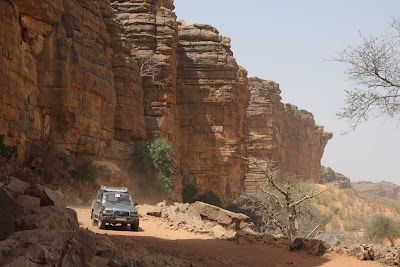 Here you can see one of our 4X4 vehicles driving at the base of the escarpment. I was in heaven for sure. It was composed of a coarse sand and I guessed it's age as Precambrian or Cambrian. We'll see when we get home.
 The town of Mopti is located on the banks of the Niger River, one of the planets largest and most important rivers. We visited during the low, dry season but that didn't stop the lively traffic of people and goods moving along the river. I don't think I've seen anything as exotic as scenes like this.
 Here's a last look at a man piloting his river boat on the Niger.
Checking out for now but perhaps back later!
 This is a baobab tree. They are found all over Africa but this is the first time I've seen them in Mali. We were driving out to the Dogon Country when I snapped this shot. During the rainy season it will sprout leaves.
 We finally arrived at the edge of the cliff. The air quality was really bad as you can see as there had been a whole summer of Sahara wind storms. Anyway, the cliff of sandstone was phenomenal.
 No, this is not Mesa Verde in Colorado! It's actually a Dogon village in the country of Mali. Wow. Looks just like an Anasazi cliff dwelling. A very interesting stop indeed.
 Here's a closeup view of the next village we saw and it's called Ireli. It is located beneath the cliff n just like the previous shot. Amazing!
 Here you can see one of our 4X4 vehicles driving at the base of the escarpment. I was in heaven for sure. It was composed of a coarse sand and I guessed it's age as Precambrian or Cambrian. We'll see when we get home.
 The town of Mopti is located on the banks of the Niger River, one of the planets largest and most important rivers. We visited during the low, dry season but that didn't stop the lively traffic of people and goods moving along the river. I don't think I've seen anything as exotic as scenes like this.
 Here's a last look at a man piloting his river boat on the Niger.
Checking out for now but perhaps back later!
Subscribe to:
Posts (Atom)