Saturday, May 05, 2018

Central Asia - Kyrgyzstan and Turkmenistan

We are now in the air flying to Iran. There was a social media blackout in Turkmenistan and I was unable post from there. So, I will publish as much as I can in this 2 hour flight and at least get the photos online.

Kyrgyzstan (see link for this country here) 

We flew into Central Asia at the tail end of a wet cold front. You can see the rain disappearing in the upper left.

And we woke up to beautiful blue skies on May 1. These are the Kyrgyz Mountains to the south from our hotel in the capital city of Bishkek.

This is the restored Burana Tower located on a branch of the Silk Road.

Stone crafted headstones in the cemetery area.

 Another headstone made of granite. The mountains in the distance are located in Kazakstan.

A definite East Asian look in this figure.

 Mill stones made of granite.

 A large fault, the Issyk-Ata fault runs along the base of the mountains. These faults result ultimately from the collision of India with Asia to the east of here.

We also enjoyed an eagle demonstration while at the tower.

A regal bird. I observed a very deep connection between the bird and its master.

The demonstration included the bird flying in to catch a rabbit (already made into meat).

Devouring the rabbit.

The national dish is called plov (pilaf with a flour crust).

This yurt was assembled in 12 minutes. The ones who assembled it routinely engage in competition of this type.

Turkmenistan (see a link for the country here)

Flying over the Karakum Desert, 12th largest in the world and covered mainly in sand dunes. The dark areas are oases in the desert.


Note the main canal running across the view, with subsidiary canals and agricultural areas in green. Turkmenistan grows a lot of cotton.

All I can say is that the capital of Ashgabat is unusual! This is the new international terminal shaped like a falcon. Most buildings are faced with marble, much of it from Carrera, Italy.

The East Asia Games were hosted here in 2017 and this stadium was built for the event.

This is an entirely planned community.

Planted forest within the city.

The horse is revered in Turkmenistan.

Monument to Independence from the Soviet Union (acquired in 1991).

This is the 1st President (1991-2006).

It is a marginally Muslim country but statues of people are everywhere.

View of the "White City" from my hotel room.

The Ancient City of Merv see the link here)

We used our 757 to "commute" to the city of Mary (pronounced MAR-ee). About 30 miles away is the ancient city of Merv.

Merv is known as one of the great cities along the Silk Road, in existence from the 2nd century BC until the 17th century.

The Sultan Sanjar tomb (left) was built in 1157 for the leader of the Seljuk Empire. The Great Kyz Kala (right) was constructed in the 8th or 9th century.

Close-up with restoration underway.

The Little Kyz Kala.

View from Little Kyz to Great Kyz.

This is the oldest ruin in the Merv complex, Erk Kala.

View from the top of Erk Kala.

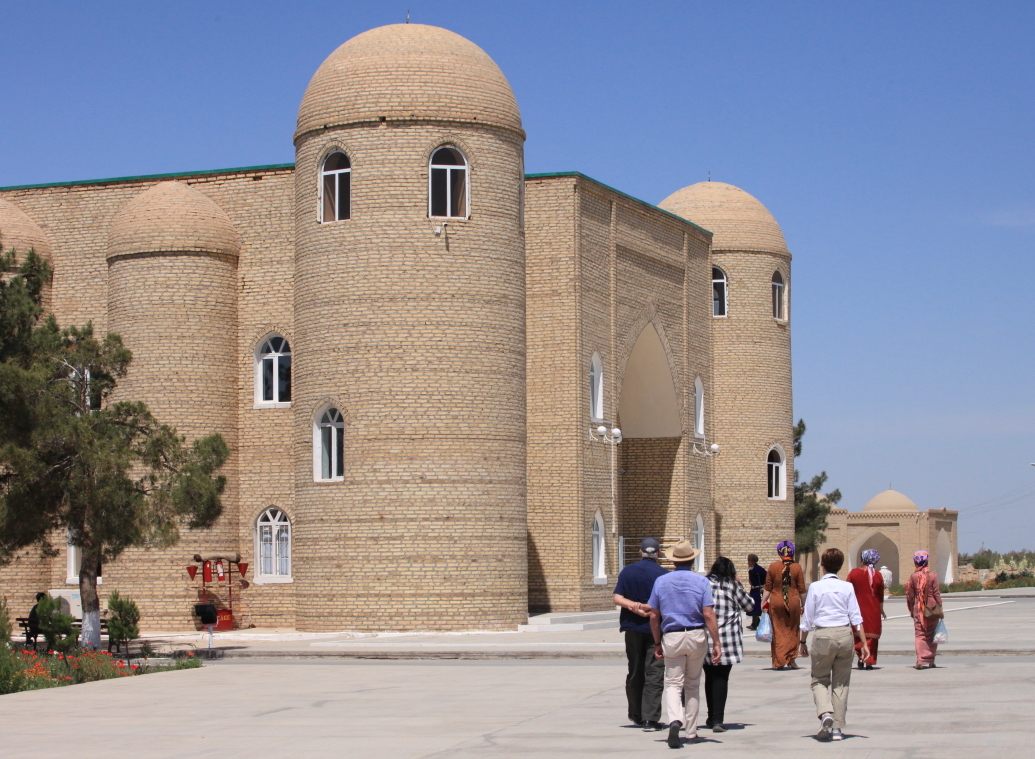
This the Mosque of Yusef Hamadani. We did not go inside. But that was not a disappointment because there was so much activity outside the mosque...

...a huge religious feast was being prepared for the local people, providing a great opportunity for photographs.


Local ladies outside  the mosque.

They walk three times counter-clockwise around this structure.

Meanwhile this Turkman provided an interesting profile.

The tour ends up at the Sultan Sanjar tomb.

It was a lot darker than this inside but I set the ISO setting to 6400 and it all came out right.

The mosque in Mary. Now on to Iran.

Tuesday, May 01, 2018

Who Knew - Lithuania is a Gem

If you, like me, grew up during the Cold War, your childhood education likely included black and white grainy images of the old Soviet Union. Perhaps the photos were of mole-ladened, ladies wearing wool scarfs as they stood in a long bread line on a cold winters day. Or of obedient peasants gathering wheat with hand-held sickles. Whatever those images were meant to convey, they painted a picture of a stone cold, lifeless humanity - a huge Soviet monoculture devoid of anything unique. The name 'Lithuania' created visions for me of a grey, lifeless existence. However, between what what my government wanted me to think and what it actually was (and is) is something quite different. The Lithuanians never were Soviets or even Russian. They had too long a history of their own that pre-dated the Czars and even Russia as a political and cultural entity. My first visit here revealed something dynamic and alive in a country and culture with a long, interesting history. I loved this first stop on our trip and would go back in a heartbeat.

The word 'Lithuania' first appears in written records in the year 1003 AD, but the Romans spoke of a people living here as early as 7 AD, whom they called the Balts. A succession of nobles, knights and kings is recorded, people who spoke a language that even today preserves elements of a pre-Medieval tongue that was spoken across the northern plains of Europe. The country once stretched from the Baltic to the Black Sea whose people successively resisted the Golden Horde, Teutonic Knights, Russian Czars, and (eventually and successfully) the Nazi's and the Soviets. Cultural success was rooted, perhaps surprisingly, in an overt tolerance for others - a tolerance not often heard of in the development of many Western societies. Lithuanians retained a pagan way of life through the 14th century, comfortable in their ancient, polytheistic worldview. Eventually Catholicism reached Lithuania and the Protestant Reformation was much less successful here (and likely resulted from suspicions of the successors to those Teutonic Knights). The country remains dominantly Catholic today.

Vilnius is the capital and is located at the junction of two rivers with a hill conveniently located at the rivers' confluence. The setting was an ideal location for a castle, a city, and a nation.

We visited the Museum of the Palace of the Grand Dukes of Lithuania, where paintings of old Vilnius were seen. Note the small river wrapping around the semi-circular wooden stockade on the left. A perfect place to built a city! Note the hill (called a mountain in Lithuania) in the background with another fortification on top. This image is from the 12th century, before the use of locally made red bricks began in the 13th century.

The bell tower and the National Cathedral at night. These modern structures sit just inside of where the semi-circular stockade wall was seen in the previous image. Our hotel was located just across the street from these two structures. The semi-circular river is now drained and a semi-circular street is on top of it.

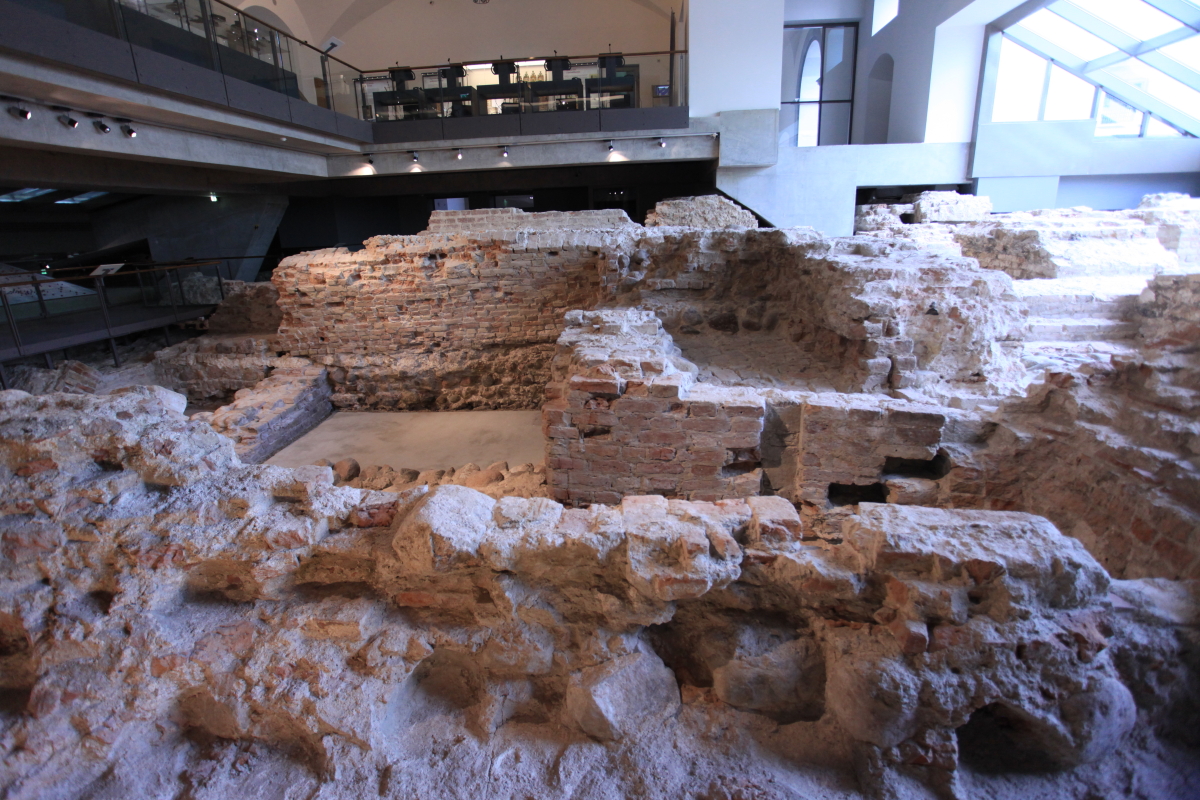
The foundations of the first brick castle were laid in the 13th century and were recently excavated with a modern museum constructed on top of them. What an incredible exhibit within, charting the development of and Vilnius and Lithuania from the retreat of the Scandinavian Ice Sheet some 10,000 years ago to the present. The displays are phenomenal! Artifacts from the Stone Age were uncovered in the excavations but revealed that construction in Medieval times disrupted much of this early prehistory.

A model in the museum showing the layout of the earliest castle and the landscape elements that determined its location. The location, within the bend of the little river, separated the dukes and other nobles from the commoners and their homes outside this natural boundary.

By the 17th century the complex had grown more intricate. In this model, existing buildings have color and those no longer in existence are made of white foam. Note the clock tower on the far left and the Cathedral just to the right of it (brown color). Only one tower remains of the hilltop fortification (seen in the following photo).

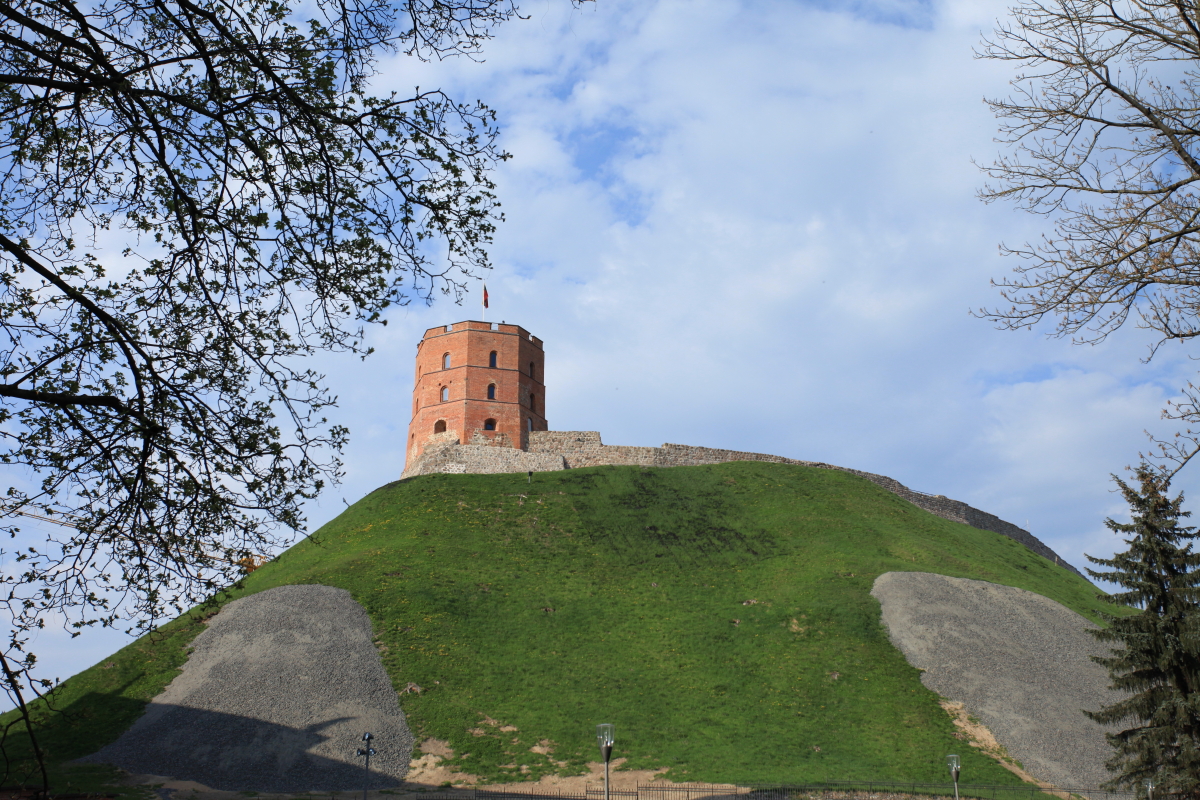
This is about all that is left of the hilltop fortress. Note the grey scars on the slopes - these are where recent slips or landslides have been reinforced.

As the castle nearby grew in importance, so did Old Town Vilnius.

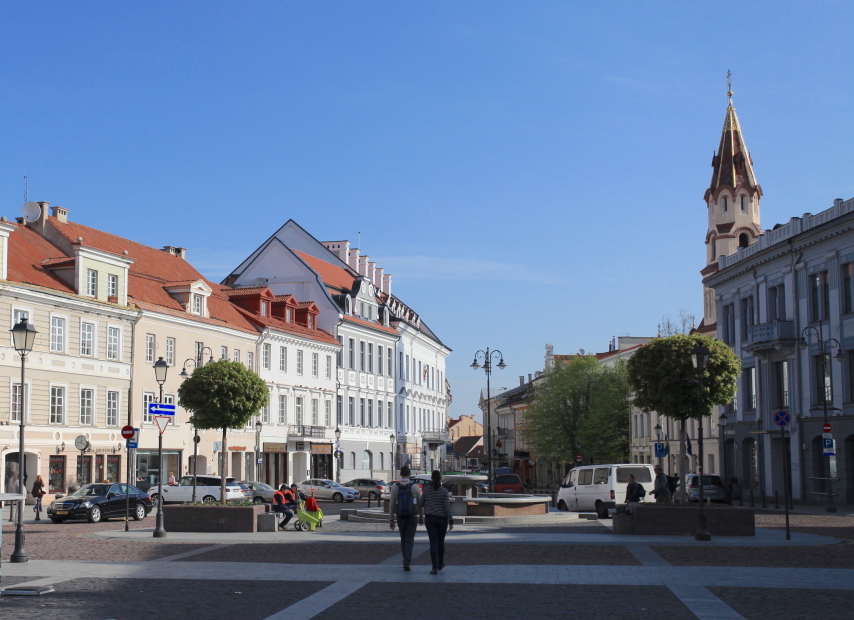
Old Town has many narrow, winding streets that are a holdover from Medieval times.

We had a great walk trough the Old Town and I took many pictures.

Vilnius is called "The Greenest Capital in Europe," at least in Lithuania. I have not been to all the capitals to know if this is true or not but it certainly is green.

It is a lively place with many post-recession sidewalk cafes.

Colorful bicycles for rent to get around Old Town.

From the University Library (founded in 1579) I leaned out a window to capture a view of the old and the new. Since 2004, the skyscrapers across the Neris River have grown.

From the top of the Palace of the Grand Dukes, I captured this view back toward the University. Note the old Lithuanian flag with the proverbial knight on a white horse. This flag was only replaced in 2004 as the official flag of the country. Lithuania was the first Soviet Republic to say "No thanks" to continued inclusion in the USSR after Mikhail Gorbachov let countries decide whether to stay or not (glasnost). The year was 1988 and it set in motion world changing events. We learned that Lithuania was always a reluctant member of the USSR.

Inside the hallways of the Palace of the Grand Dukes.

We also visited the Amber Museum. The Baltic is the richest region on earth for amber, which formed between about 50 and 44 million years ago from the resin of pine trees. It washes up on the shores of the Baltic after storms.

In the evening we drove about 45 minutes outside the city to visit the Dukes summer retreat on the shores of a lake.

Trakai is a National Historic Park and is quite beautiful in late afternoon light. The forecast was for rain but it never materialized.

Close-up of the castle with the old flag.

 View of Trakai Castle from the bridge connecting it to the mainland.

Corner tower and tree.

Here is a view of the area depicting the early 17th century area near Trakai. The castle in the foreground was destroyed by the Russians later in the 17th century and was never rebuilt. The Trakai castle is seen in the background.

TCS always arranges for special welcomes at our evening dinners.

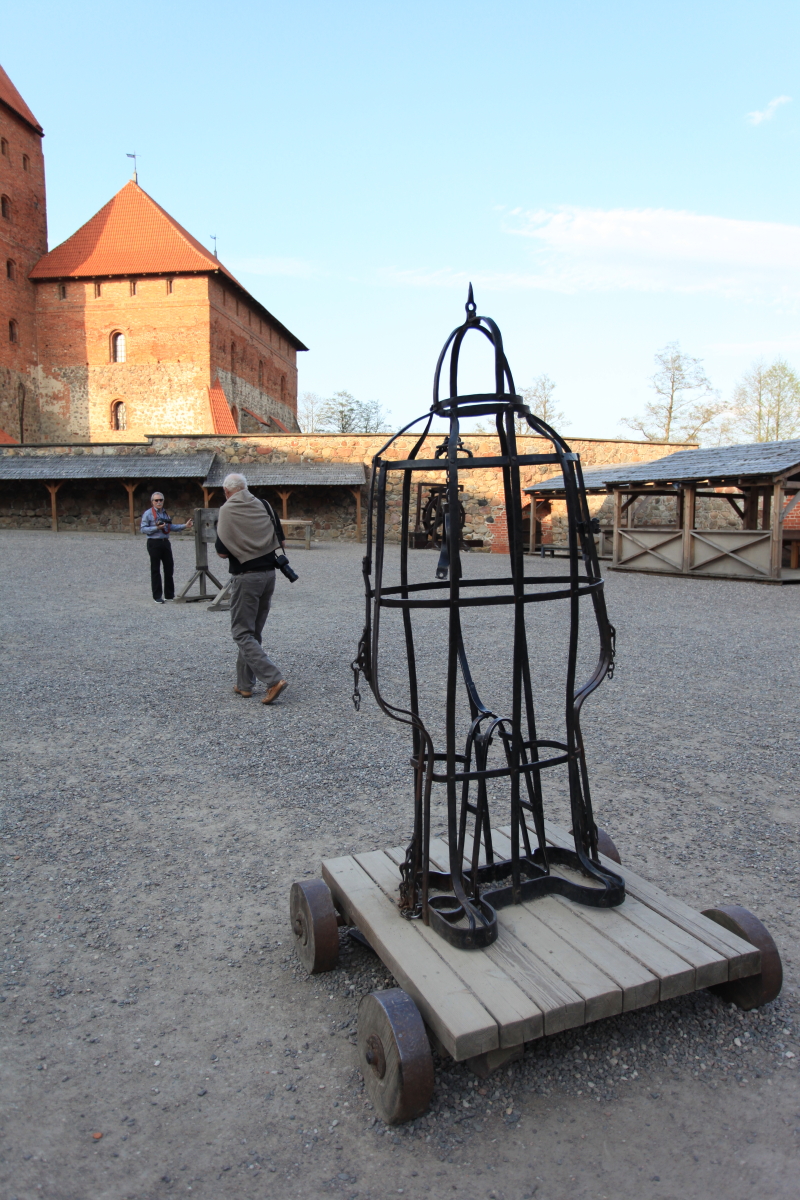
And incentives to not misbehave!

The court jester greeted everyone and was the master of ceremonies for the evening.

Which included Medieval music and dancing.

In Lithuania  hundreds of Medieval "hoards" have been found by farmers plowing their fields. The hoards typically are found in clay pots and were buried to protect from thievery. Silver and copper coins are often found. This one was on display in the castle.

Sunset on April 30, 2018 from the Trakai bridge. I hope you have enjoyed learning a bit about Lithuania. Who knew it had anything to offer the world except the occasional 7-foot tall NBA basketball player!